
[Copywriting + Ancient Wisdom]
“Isn’t charging a premium price unfair?”
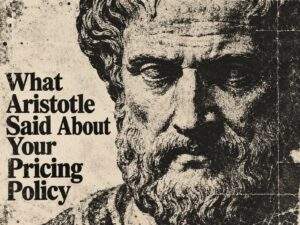
It’s not a new question. In fact, it goes back hundreds, perhaps thousands, of years. Aristotle treats commercial justice in terms of fair exchange: each side should receive equivalent value.
Notice what that does not mean.
It does not mean everything should have the lowest possible price, or match competitors exactly.
The real question is whether the buyer receives value equal to what they surrender financially.
That gives us a useful copywriting principle: premium pricing is defensible when premium value accompanies it.
That is a stronger argument than simply saying, “Charge whatever the market will bear.”
The ethical premium marketer should focus not merely on extracting more money, but creating much greater value.
Ideally, the inequality should run in the customer’s favor: they receive considerably more than they pay.
Charge more, but become worth considerably more in ways the customer can clearly recognize.
The ethical copywriter does not merely increase desire; he demonstrates the fairness of the exchange.
The prospect thinks, “You’re asking me to surrender $10,000,” and the copywriter must answer clearly.
They must show what stands on the other side of the scale: the problem removed, the result gained, the time saved, the risks avoided, the alternatives replaced, and the long-term economic value created.
In effect, the copywriter is building the scales of justice inside the prospect’s mind. Price goes on one side; demonstrated value goes on the other.
The sale occurs when the buyer judges that exchange worthwhile, fair, and advantageous overall.
RW
.
.
.