
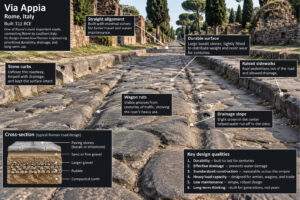
Rome did not prove its engineering skill with one impressive road.
It proved it by building roads again and again.
By the time Roman engineers began another road, bridge, aqueduct, or fortification, they were not starting from zero. They carried forward techniques that had worked elsewhere, corrections learned from failure, and standards refined through repeated use. One successful road could be luck. Thousands of miles of durable roads suggested a system.
That accumulated proof offers a useful lesson for sales language.
When buyers encounter a new offer, they wonder how much of it is experimental. A method invented for this morning’s sales page carries less weight than one shaped by ideas that have survived years of use, testing, failure, and refinement.
You do not need an old company to create that sense of continuity. The history can belong to the method.
A copywriter can point to direct-response principles tested across decades. A consultant can explain how a process emerged from seeing the same operational failure across fifty companies. A creator can show how modern content methods rest on older principles of narrative and teaching.
The mistake is simply saying your approach is “based on proven principles.” That is a claim, not proof.
Show the lineage. Explain where the method came from, what failures changed it, what was discarded, what survived, and why those surviving principles still solve the buyer’s problem today.
Rome’s advantage was not merely age.
It had accumulated answers.
Your sales language should show that your method has, too.
RW
.
.
.