
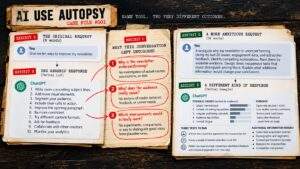
A copywriter asks AI for ten ways to improve a newsletter.
Seconds later, the screen fills with familiar suggestions: write stronger subject lines, improve consistency, segment the audience, experiment with formats.
Nothing particularly wrong there. Nothing particularly ambitious, either.
Look at the accompanying case file. It shows how an ordinary request can keep an extraordinary tool occupied with an embarrassingly small job.
The missing element is 𝘪𝘯𝘷𝘦𝘴𝘵𝘪𝘨𝘢𝘵𝘪𝘰𝘯.
Why are readers leaving? Which issues hold attention? What do subscribers complain about? Are the apparent problems caused by subject lines, poor targeting, or something else entirely?
These questions demand more than a list of tips. They require evidence, competing explanations, and experiments capable of proving our favorite assumptions wrong.
A more ambitious AI request could help examine twenty past issues, organize subscriber feedback, propose hypotheses, and design inexpensive tests.
The model may still get things wrong. It needs real data, and somebody must challenge its conclusions. Yet the work has moved into an entirely different category.
This is where the AI revolution gets interesting for small publishers and entrepreneurs.
Research projects that once seemed too expensive or laborious may now be worth attempting. The opportunity extends beyond writing faster. We can investigate problems we previously had to ignore.
But access to extraordinary capabilities doesn’t automatically expand anyone’s ambition.
The tool will cheerfully give you ten tips. It may also help you discover why your business is losing customers.
The question is which assignment you think to give it.
RW
.
.
.