
The best bullet points aren’t “one and done,” they’re combination punches.
Here is a Jason Fladlien bullet, selling a webinar mastery book:
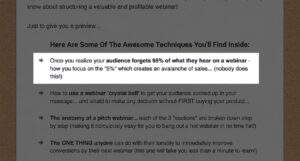
“Once you realize your audience forgets 95% of what they hear on a webinar -how you focus on the “5%” which creates an avalanche of sales… (nobody does this!)”
This bullet works because it combines a startling fact, a hidden mechanism, a highly desirable payoff, and an information gap in just a few lines.
There is a lot to unpack here. It starts with a surprising, highly specific problem.
“Your audience forgets 95%…”
That number gives the bullet concreteness. It doesn’t say, “People forget most webinars.” It gives you 95%.
More importantly, the statistic immediately creates curiosity:
“If they forget 95%… what on earth should I be saying?”
Now the reader has a problem they may not have realized they had.
It turns the negative fact into a positive opportunity.
The bullet could have stopped at:
“Your audience forgets 95% of what they hear.”
That would merely be interesting.
Instead it pivots:
“…how you focus on the 5%…”
That is the real selling move.
The 95% creates the problem.
The 5% suggests the mechanism.
So psychologically, the bullet moves:
Problem, hidden distinction, solution.
That is much stronger than simply promising “better webinar conversions.”
The “5%” becomes a curiosity mechanism.
This is probably the strongest part.
The prospect now wants to know:
“What is the 5%?”
“Which parts of my webinar belong in it?”
“Am I currently concentrating on the wrong 95%?”
“How do I identify the 5%?”
The bullet deliberately withholds the answer.
Rather than just giving away the information the prospect will discover, Jason teases it.
You are selling the discovery.
It connects the mechanism directly to the desired result.
Notice it does not say:
“…the 5% people remember.”
It says:
“…the 5% which creates an avalanche of sales.”
Why? Because the prospect doesn’t just want better retention.
They want sales.
So the bullet transforms an intellectual insight into a commercial benefit.
The chain: memory, to persuasion, to sales.
Clayton Makepeace repeatedly stressed connecting tangible benefits to the prospect’s deeper desires and dominant emotions rather than stopping at surface-level features.
“Avalanche of sales” dimensionalizes the payoff.
“Avalanche” is much stronger than:
“more sales.”
It creates movement, excitement, scale and imagery.
You can almost picture orders cascading in. This is the power of metaphor.
“Nobody does this!” adds novelty and exclusivity.
This little parenthetical does quite a bit of work.
It implies:
“You haven’t heard this before.”
“Your competitors don’t know it.”
“This isn’t ordinary webinar advice.”
That raises curiosity again because the reader starts thinking:
“If nobody is doing this, what does this person know that everybody else doesn’t?”
It converts a technique into something resembling proprietary knowledge. That makes the information feel more valuable.
Psychological Loops
The bullet creates two curiosity loops, not one.
This is subtle.
Loop #1:
“Why do they forget 95%?”
Loop #2:
“What exactly is the profitable 5%?”
Then “nobody does this!” creates an implied third:
“Why hasn’t anyone else figured this out?”
So the reader has multiple unanswered questions pulling them forward that only buying product will answer.
The Not So Good…
There is one important weakness: the 95% figure carries a proof burden. Because it is so specific, readers can wonder where it came from. If the underlying material can’t substantiate the statistic, the specificity that makes the bullet powerful can also hurt credibility.
The deeper structure worth swiping is:
- Surprising fact/problem
- Overlooked minority
- Hidden mechanism
- Oversized desired result
- Exclusivity kicker
For example:
“Once you discover why 93% of prospects mentally check out before your pitch — how to engineer the handful of moments that make buying feel inevitable… (almost every webinar gets these backwards!)”
That is the architecture making your original bullet work, not merely the wording.
RW
.
.
.