
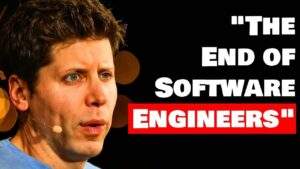
Coming out against clickbait in 2026 isn’t exactly a brave and powerful stance, I get it. However, I do see teachable moments here, through the lens of General Semantics indexing:
“The end of software engineers.”
All software engineers?
Backend?
Frontend?
Embedded?
Safety-critical?
Infrastructure?
Security?
Data?
ML?
Firmware?
Systems?
Enterprise integration?
In every country?
At every company?
At every level of experience?
By what date?
And what exactly has ended?
Writing code?
Designing systems?
Debugging?
Understanding requirements?
Making tradeoffs?
Integrating unreliable components?
Maintaining legacy systems?
Deciding what the software should do?
You have taken a profession containing thousands of different tasks and compressed it into one noun:
software engineer
Then you took a changing distribution of tasks and compressed that into one event:
the end.
Very clean sentence.
Very dirty map.
Perhaps AI reduces the amount of hand-written code required for some tasks.
Perhaps one engineer can do work that previously required several.
Perhaps junior hiring changes.
Perhaps some specialties shrink while others grow.
Perhaps the job becomes more about specification, verification, architecture, integration, and judgment.
Those possibilities deserve investigation.
But none of them logically equals:
THE END OF SOFTWARE ENGINEERS.
A useful Korzybskian translation:
“Current AI tools appear capable of automating portions of software-development work, which may change the number and kinds of engineers some organizations hire.”
Less satisfying.
No tombstone.
No apocalypse.
Also much closer to something one could actually test.
RW
.
.
.