
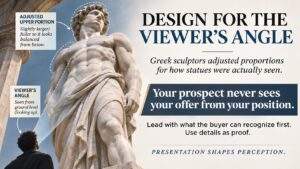
Ancient Greek sculptors faced a problem: the human eye could make a proportioned statue look wrong.
In Plato’s 𝘚𝘰𝘱𝘩𝘪𝘴𝘵, a speaker describes artists making large works for viewers standing far below. If they preserved the correct proportions, the upper parts could appear too small. So artists sometimes exaggerated those parts to produce a more convincing appearance.
Whether this describes a widespread sculptural practice is debated. But the problem Plato identified is familiar to anyone who writes advertising.
𝗬𝗼𝘂𝗿 𝗽𝗿𝗼𝘀𝗽𝗲𝗰𝘁 𝗻𝗲𝘃𝗲𝗿 𝘀𝗲𝗲𝘀 𝘆𝗼𝘂𝗿 𝗼𝗳𝗳𝗲𝗿 𝗳𝗿𝗼𝗺 𝙮𝙤𝙪𝙧 𝗽𝗼𝘀𝗶𝘁𝗶𝗼𝗻.
You know the product. You understand the features. You’ve spent weeks studying what makes it valuable.
Your reader sees a headline, a few sentences, and maybe a photograph before deciding whether to continue.
Imagine selling a course that teaches freelancers how to find profitable clients. Your draft opens with the course’s twelve modules, thirty-seven lessons, downloadable worksheets, and video library.
Every detail may be accurate. Yet the reader still has to do the work of figuring out why any of it matters.
Try moving the outcome to the foreground: “Find better freelance clients without spending your evenings sending cold pitches.”
Then use the modules, worksheets, and lessons to support that promise, provided the course can deliver it.
You haven’t changed the product. You’ve changed which part the buyer sees first.
That’s the useful lesson from the sculptor’s dilemma: 𝗱𝗲𝘀𝗶𝗴𝗻 𝗳𝗼𝗿 𝘁𝗵𝗲 𝗮𝘂𝗱𝗶𝗲𝗻𝗰𝗲’𝘀 𝘃𝗶𝗲𝘄𝗶𝗻𝗴 𝗰𝗼𝗻𝗱𝗶𝘁𝗶𝗼𝗻𝘀.
Before polishing another sentence, ask: What looks obvious from where I stand but almost invisible from where my prospect stands?
RW
.
.
.