
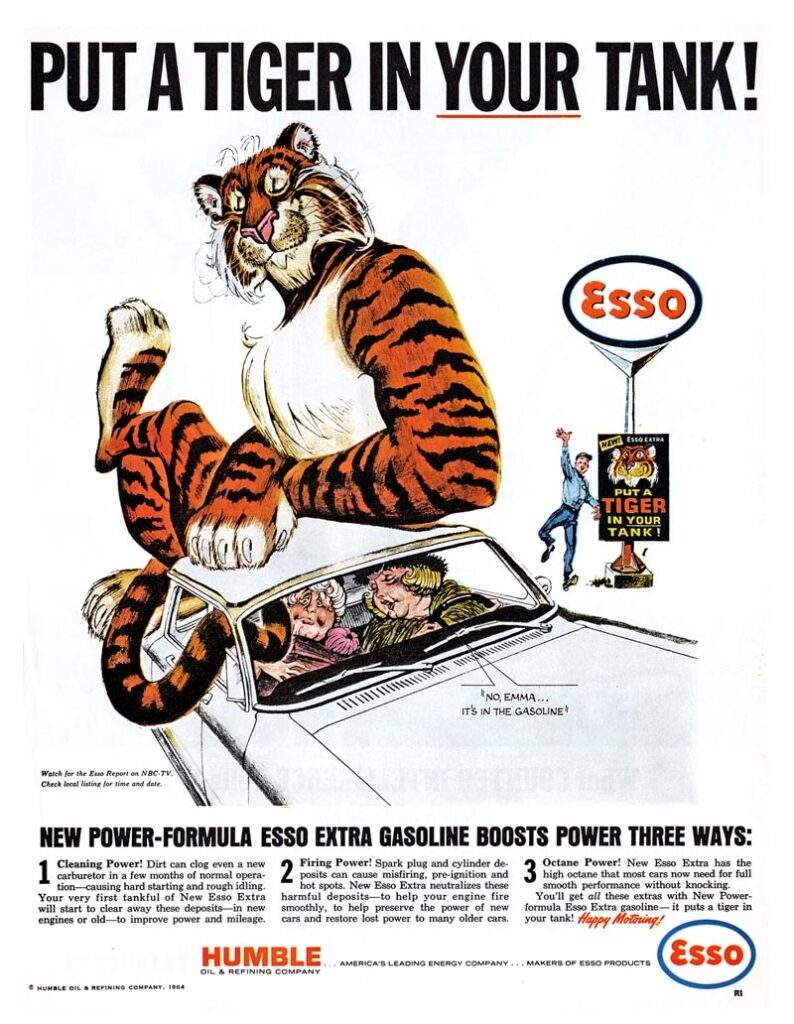
A giant tiger sits across the roof of a car, its paws hanging beside the windows and its striped tail curling around the bodywork. Above it, the headline gives the driver an impossible instruction: “Put a Tiger in Your Tank!”
The image is absurd enough to stop the eye and clear enough to explain itself. The tiger gives gasoline a body. Muscle represents stored strength. A pounce suggests acceleration. Claws and teeth supply aggression. Filling the tank becomes the act of harnessing a predator’s power and carrying it onto the road.
The Verb That Makes the Metaphor Work
The slogan, which ExxonMobil records as originating in 1959, gains much of its force from the word put. This is an action the customer can perform. The tiger becomes something the driver loads into the car at the service station, ready to release when the accelerator goes down.
The comparison gives the customer a role, and the product a character. Gasoline acquires an animal spirit. The message can then expand through stripes, tails, movement, growls, and playful encounters between drivers and oversized cats.
The cartoon adds another layer. Two women sit beneath the enormous tiger, and a small caption reads, “No, Emma . . . it’s in the gasoline!” The line resolves the visual joke while directing attention back to the product. It anchors the animal’s power inside Esso Extra and keeps the gag tied to the gasoline.
The Bottom Copy Turns Excitement Into Evidence
The upper portion of the ad creates desire. The copy block at the bottom supplies reasons to believe. Its headline reads: “New Power-Formula Esso Extra Gasoline Boosts Power Three Ways.” That sentence translates the tiger’s broad promise into a specific, numbered case.
The repetition of power preserves the connection with the image. “Three ways” creates a closed information gap: the reader knows exactly how much evidence is coming. The numbered columns also make technical material easier to scan.
Each column follows a compact problem-mechanism-payoff sequence. “Cleaning Power” begins with dirt clogging a carburetor, then names recognizable symptoms: hard starting and rough idling. Esso Extra will “start to clear away” the deposits from the first tankful, with improved power and mileage as the promised payoff.
“Firing Power” moves deeper into the engine. Deposits on spark plugs and cylinders can cause misfiring, pre-ignition, and hot spots. The gasoline is said to neutralize those deposits, helping a new car preserve its power and an older car restore power it has lost. That preserve-or-restore distinction expands the market without adding a separate pitch.
“Octane Power” addresses knocking. High octane is tied to “full smooth performance,” giving the technical feature an observable consequence. The three columns therefore cover cleanliness, combustion, and octane while keeping every explanation attached to the same central promise: power.
The language is also carefully measured. Phrases such as “start to clear,” “help preserve,” and “help your engine fire smoothly” avoid promising an instant mechanical cure. Those qualifications make the claims sound more credible without draining them of value.
The final sentence returns to the slogan: “It puts a tiger in your tank!” After the technical case has been made, the copy hands the reader back the image most likely to survive.
Practical Takeaways for Copywriters
First, give an invisible benefit a visible form. Find an animal, object, person, or action that already embodies the quality your product promises.
Second, choose a metaphor that can generate scenes and customer actions. “Put” makes the buyer part of the idea.
Third, place proof beneath the promise. Organize features into a small number of named reasons, then connect each feature to a symptom or outcome the customer can recognize.
Finally, repeat the central language throughout the ad. Esso moves from tiger to power, from power to three mechanical explanations, and from those explanations back to the tiger. The reader leaves with one unified image carrying the weight of the entire argument.
RW
.
.
.