A sales page has a strange problem.
The same reader who wants excitement at the top may want sober proof halfway down. The person who needs to feel understood in one section may want you to stop empathizing and explain exactly how the thing works in the next.
Yet a lot of sales pages are written as though the reader stays psychologically frozen from headline to checkout.
The writer finds a tone and keeps hammering it.
Urgent at the top. Urgent in the problem section. Urgent through the proof. Urgent all the way to the order button.
That misses something important.
As people move through a sales page, what they want from the copy changes.
So instead of asking, “Is this section persuasive?” ask a narrower question:
What does the reader want from me right here?
That question changes how you write almost every part of the page.
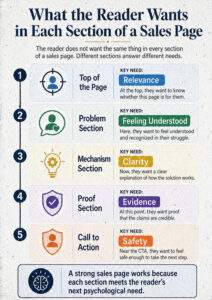
At the top, they want to know if they should keep reading
The hero section has a simple job.
The reader has landed on the page and is making a fast sorting decision.
“Is this relevant to me?”
They don’t need your life story yet. They don’t need twelve testimonials. They probably don’t need a detailed explanation of your mechanism.
They need orientation.
Tell them what this is, who it is for, and what useful result it promises.
A strong headline and subheadline often do most of the work.
In the problem section, they want recognition
Once the reader decides the page is relevant, the question changes.
Now they’re looking for evidence that you understand the situation they’re actually in.
This is where specificity matters.
Don’t tell them they are “struggling to reach their goals.” Show the recognizable symptoms of the problem. The things they have tried. The annoying consequences. The moments when the problem becomes especially obvious.
You are trying to create a small moment of recognition:
“Yes. That’s exactly what keeps happening.”
If you rush straight from headline to solution, you may be solving a problem the reader hasn’t fully connected to yet.
In the mechanism section, they want an explanation
Eventually empathy stops helping.
The reader knows you understand the problem. Fine.
Now they want to know how your solution is supposed to fix it.
This is where copy often needs to become less emotional and more mechanical.
Explain the process. Show what your product does differently. Connect the cause of the problem to the reason your method should work.
The reader’s question is no longer, “Do you understand me?”
It’s closer to:
“Okay, but why would this work?”
Answer that question clearly enough that the product stops looking like a black box.
In the proof section, they want a reason to believe you
An interesting thing happens as the sale gets closer.
Skepticism often goes up.
Early in the page, a claim can be intriguing. Later, when the reader is considering spending money, that same claim has to survive inspection.
This is where proof earns its keep.
Testimonials, case studies, demonstrations, numbers, examples, endorsements and other evidence all answer some version of:
“Do I have any reason to believe this besides the fact that you’re telling me?”
Good proof doesn’t merely decorate the claim. It carries part of the argument.
Near the decision, they want to know what could go wrong
By the time someone reaches the call to action, piling on more excitement can actually work against you.
The reader already knows what the product promises.
Now a different set of questions starts appearing.
“What if it isn’t right for me?”
“What exactly happens after I buy?”
“Can I get my money back?”
“Am I going to regret this?”
This is why guarantees, clear policies, FAQs and a simple explanation of the next step often matter so much near the end.
At this point, the copy may need to feel calmer than it did at the beginning.
You’re removing reasons to hesitate.
Audit the page by changing the question
To audit a sales page, go section by section and ask:
What does the reader need to know or feel at this exact point?
Then compare that with what the section is actually doing.
Maybe you’re pushing urgency when the reader needs an explanation.
Maybe you’re explaining when the reader first needs to feel understood.
Maybe you’re adding more benefits when the real problem is disbelief.
Maybe the final CTA is trying to whip the reader into a frenzy when they mainly want reassurance that clicking the button won’t turn into a headache.
The sales page isn’t one long persuasion argument delivered at the same volume.
The reader keeps changing.
The copy should change with them.
RW