
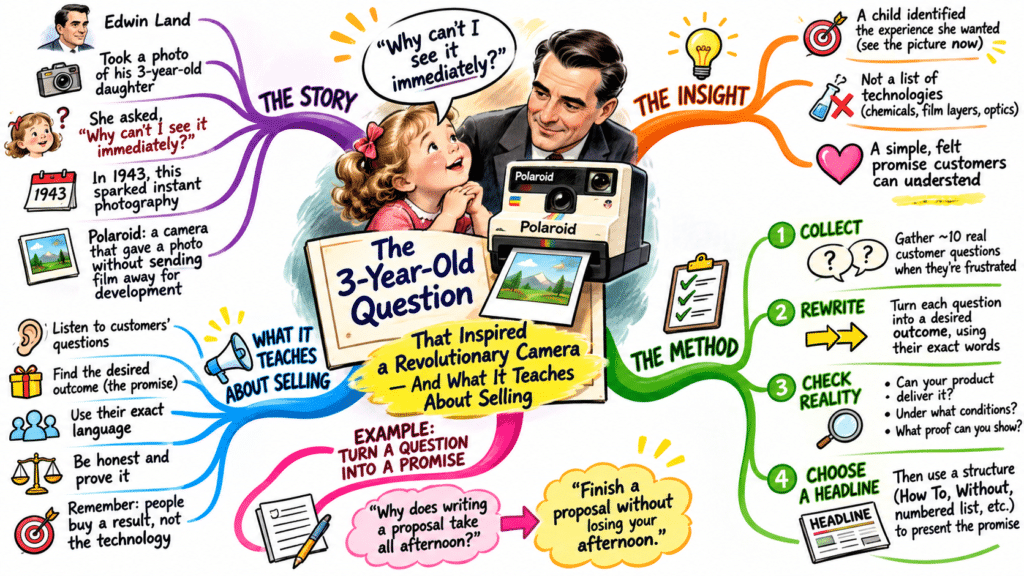
Edwin Land took a picture of his little daughter. She asked why she couldn’t see it immediately.
In 1943, that simple question helped set Land thinking about instant photography. Polaroid eventually built a camera that gave people a photograph without sending film away for ordinary development.
A child had identified the experience she wanted without knowing the technology required to deliver it.
That’s where copywriters should begin.
A camera engineer might describe chemicals, film layers, and optical components. The customer says, Why can’t I see my picture now?
The second statement points toward a promise people can feel.
Try this:
Before writing a headline, collect ten questions prospects ask when they’re frustrated. Don’t ask what features they want. Ask what they wish they could do, what makes them wait, and what seems unnecessarily difficult.
Next, rewrite each question as a desired outcome, keeping the customer’s exact words wherever possible.
Why does writing a proposal take all afternoon? becomes Finish a proposal without losing your afternoon.
Then check reality. Can your product deliver that result? Under what conditions? What proof can you show?
Only after answering those questions should you consider headline structures.
You may still use How To or Without or a numerical list. Those are containers. Your research supplies the valuable contents.
Land’s daughter didn’t ask for an innovative photographic processing system. She asked to see the picture.
Your customers may be telling you the strongest promise just as plainly. Listen before polishing.
RW
.
.
.