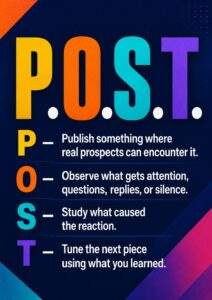
P — Publish the specimen.
O — Observe what the civilians do.
S — Study the reaction.
T — Tamper with the next version.
WHAT IT DOES:
POST prevents the copywriter from becoming a magnificent unpublished genius whose hard drive contains 413 flawless documents witnessed only by Spotlight Search.
Public writing is field research.
Release something. See what gets quoted, ignored, challenged, saved, misunderstood, or dragged into an argument by a man with an anime avatar.
Then tamper with the variables and release another specimen.
EXAMPLE:
You publish:
“Five tips for writing better sales emails.”
The internet continues rotating.
So you try:
“Find the first sentence in your sales email the reader could delete without losing anything.”
People save it.
Interesting.
The lesson isn’t necessarily “people like editing tips.” Maybe they respond to diagnostic instructions that expose a specific defect.
So you mutate the organism:
“Find the first claim on your sales page a skeptical buyer could answer with: ‘Prove it.’”
Release specimen #3.
Observe again.
USE IT WHEN:
Use POST when you’re sitting around wondering what people want to read, which angles deserve expansion, or whether an idea actually has legs.
Your private drafts can tell you what you think works.
Publication introduces the dangerous experimental variable known as OTHER HUMANS.
RW
.
.
.